Commercial duct cleaning is not residential work at a larger scale. The systems are different, the access is different, and the reason you are calling is usually different too. Most commercial calls start with a complaint, from a tenant, an employee, or an inspector, and the job is to identify what is actually causing it rather than clean everything indiscriminately and hope.
What Makes Commercial Different
The systems are bigger and there are more of them. A house has one air handler. A multi-tenant floor may have several, plus rooftop packaged units, plus a dedicated exhaust system. Cleaning one and not the others gets you a partial result and a repeat complaint.
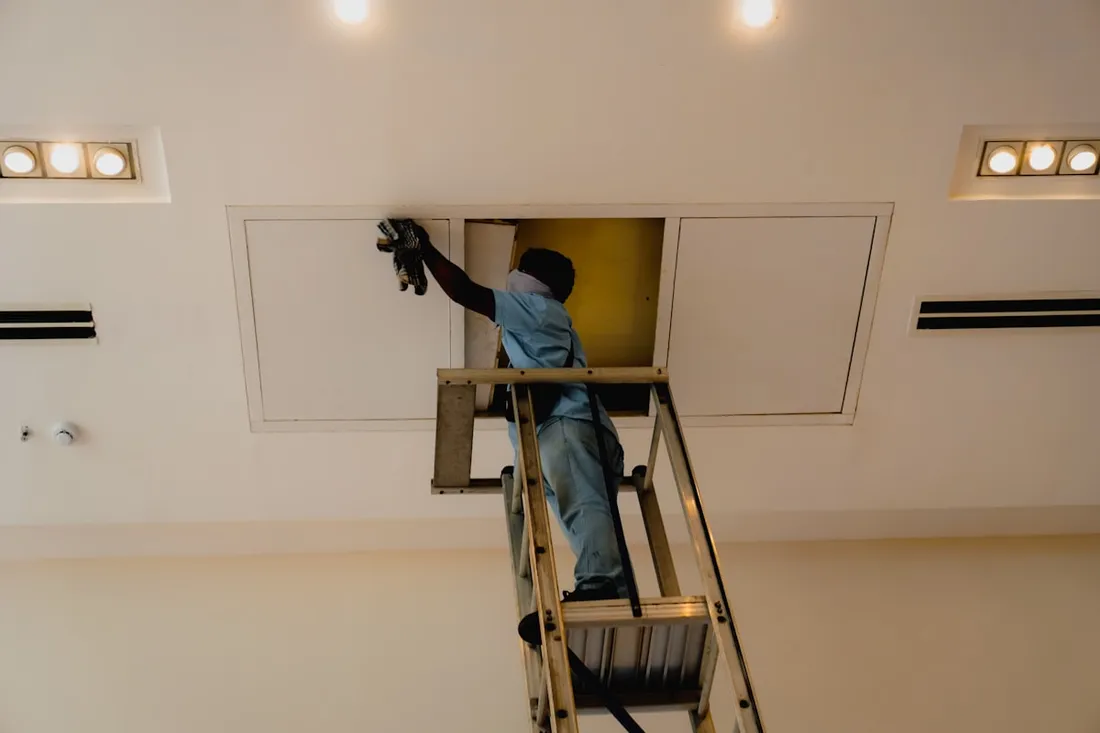
The duct is often accessible only through a ceiling grid. That means working above an occupied space, protecting finishes, and putting the ceiling back the way it was. On a residential job nobody notices a scuff in a crawl space. In a lobby they do.
Downtime has a cost. Nobody can shut off the air in a restaurant during service or a medical suite during patient hours. Almost all of this work happens after close or overnight, which has to be built into the scope and the price from the start rather than discovered later.
Somebody is accountable for the result. A property manager fielding tenant complaints, a restaurant owner facing an inspection, an office manager whose staff keep mentioning the smell. The deliverable is not just a clean system, it is documentation that the work was done.
Atlanta Buildings We Work In
- Office suites and multi-tenant floors across Midtown, Buckhead, and the Perimeter corridor, where one tenant's complaint often turns out to be a shared-system issue
- Restaurants and bars, where the makeup air and dining-room supply take on grease aerosol that ordinary filtration does not stop
- Medical and dental offices, where air quality expectations are higher and the tolerance for a musty smell in a waiting room is zero
- Salons, gyms, and pet facilities, which load a system with particulate and odor faster than almost anything else
- Multifamily properties, including unit turnover cleaning between tenants and common-area systems
- Schools, daycares, and churches, where the work has to happen on a break week or a weekend and cannot run long
Why Georgia's Climate Compounds It
Long cooling seasons and high humidity mean commercial systems here run more hours, move more air, and hold more moisture at the coil than the same equipment would in a dry climate. More runtime means more particulate deposited in the duct. Moisture at a coil or in a low-velocity section of duct means anything organic that settled there has what it needs to grow.
That is why the same building in Atlanta and in Phoenix will not be on the same cleaning interval, and why a schedule copied from a corporate standard written somewhere else often turns out to be too long here.
What the Job Involves
We inspect first and scope from what we find, not from a template. That means opening access points, running a camera through representative sections, and looking at the coil and blower rather than just the visible register faces.
Cleaning itself is source removal: the system is put under negative pressure with HEPA-filtered collection so that everything dislodged goes into the machine rather than into the building. Agitation tools work each run, supply and return separately. The air handler, blower compartment, and coil get cleaned as part of the job, because a spotless duct feeding a fouled coil is theater.
You get before-and-after documentation on the sections we service. If you are answering to a tenant, a client, or an inspector, that record is often the point.
What Commercial Duct Cleaning Costs in Atlanta
Commercial work is quoted per building, not from a price list, because the variables that matter are specific to your space:
- Linear footage of duct and the number of supply and return runs
- Number of air handlers or rooftop units in the scope
- Access. Open warehouse ceiling versus a finished ceiling grid in an occupied suite is a large labor difference.
- What is in the system. Ordinary office dust and restaurant grease aerosol are not the same job.
- Scheduling. Overnight and weekend work is standard for us but it is priced accordingly.
- Whether coil cleaning and sanitizing are included. On most commercial jobs they should be.
We walk the building before quoting. A number given over the phone without seeing the system is a number that changes later, and property managers have been burned by that often enough to be right about distrusting it.
Frequently Asked Questions
Do you work after hours?
Most of our commercial work happens after close or overnight, because that is when the building is empty and the system can be shut down safely. Restaurants, medical suites, and offices all get scheduled around their own hours rather than ours. We build the access plan around your operating schedule before quoting.
How is commercial duct cleaning priced compared to residential?
Residential is usually a flat per-system price. Commercial is scoped by the linear footage of duct, the number of air handlers and rooftop units, and how hard the runs are to reach. A small suite with one packaged unit prices close to a large house. A multi-tenant floor with several air handlers and a ceiling grid to work around does not.
How often should a commercial system be cleaned?
It depends far more on what the building does than on how old it is. A professional office with good filtration can go several years. A restaurant, a gym, a salon, a pet facility, or anything with heavy particulate or grease in the air needs it far more often. If you are getting tenant complaints about odor or dust, that is the signal regardless of the calendar.
Will you shut down our HVAC?
Only for the portion being worked on, and only when it is scheduled with you. On multi-unit buildings we work unit by unit so the rest of the space stays conditioned. On a single-system building we plan the shutdown for the window where it affects the fewest people, which is one more reason most of this work happens overnight.
Also managing a coil or airflow issue? See HVAC coil cleaning and duct sealing, or view our full list of services.